

- Home
- »
- Security
Bank-Level Protection for Your Financial Data
QuickQore is built on enterprise-grade infrastructure, multi-layer protection, and strict operational controls — protecting bank, payroll, vendor, and reporting data at every stage. Bank-level AES-256 encryption, TLS 1.3 in transit, two-factor authentication on every login, role-based access, read-only bank API integration, and three geographically separated copies of your data.
Security at a Glance
End-to-End
Encryption
Data in transit + at rest (AES-256)
Two-Factor
Authentication
2FA on every login — no exceptions
Never Ask For
Bank Passwords
Read-only API via Plaid
3-Layer
Backup System
Primary + secondary + offsite
Role-Based
Access Control
Need-to-know only
Data Masking
Last 4 Digits Only
Bank & routing # masked
Important Notice — This Page Is Informational
Is your data secure with QuickQore?
YES — bank-level encryption, multi-layer architecture, and strict internal controls protect your books at every stage.
- Secure bank integrations (Plaid, read-only)
- Multi-layer backup systems (3 geo-separate copies)
- Two-factor authentication (every login, every plan)
- Physical & network-level security
- Advanced encryption protocols (AES-256, TLS 1.3)
- Role-based access control (need-to-know only)
- Managed hosting infrastructure (US-based, SOC 2 data centers)
- Continuous 24/7 anomaly monitoring
QuickQore is one of the most secure cloud bookkeeping platforms available to small businesses, multi-location operators, and CPA firms in the United States.
Credential Promise
QuickQore will NEVER ask for your bank username or password.
No credential sharing
No unauthorized access
Full control stays with the account owner
Multi-Layer Security Architecture
Three independent layers — every threat has to defeat all three before it can reach your books. Each layer is monitored, logged, and audited independently.
Answer
QuickQore’s security architecture is built in three independent defense-in-depth layers: Layer 1 Network Security (perimeter firewall, intrusion detection, 24/7 anomaly monitoring), Layer 2 Application Security (secure login, 2FA, session protection, input validation), and Layer 3 Data Security (AES-256 encryption, bank-account masking, restricted internal visibility). A breach must defeat all three layers to reach customer data.
Layer 1
Network Security
Perimeter defense — keeping threats out.
- High-security firewall protection
- Intrusion detection & prevention (IDS/IPS)
- Fully secured network architecture
- Continuous network monitoring
24/7 anomaly detection — auto-blocks suspicious traffic
Layer 2
Application Security
Login, identity, and session protection.
- Secure login systems (TOTP, FIDO2/WebAuthn)
- Strong authentication protocols
- Input validation & system hardening
- Protection against unauthorized access
2FA enforced on every account — no exceptions
Layer 3
Data Security
The data itself — masked, encrypted, restricted.
- Encryption of sensitive data (AES-256)
- Bank account & routing # masking
- Restricted internal data visibility
- Secure data handling processes
Even our team only sees the last 4 digits
Every layer, every device, every person
From your data on disk to the people handling it — nine operational pillars are applied end to end. Each is documented, trained, monitored, and audited on a fixed cadence.
Answer
QuickQore’s security architecture is built in three independent defense-in-depth layers: Layer 1 Network Security (perimeter firewall, intrusion detection, 24/7 anomaly monitoring), Layer 2 Application Security (secure login, 2FA, session protection, input validation), and Layer 3 Data Security (AES-256 encryption, bank-account masking, restricted internal visibility). A breach must defeat all three layers to reach customer data.
Pillar 1
Bank-Level Encryption
Every byte, every connection, every database record is protected with cryptography that meets US banking and federal data standards.
- End-to-end AES-256 encryption at rest
- TLS 1.3 on all HTTPS & API connections
- Protected data pipelines, no plain-text logging
- Encryption keys rotated and HSM-managed
Pillar 2
Two-Factor Authentication
Even if a password leaks, your account stays protected. 2FA is enforced on every login on every plan.
- 2FA on every login (TOTP, SMS backup)
- Hardware security keys (FIDO2/WebAuthn) on Enterprise
- Session-level protection & rotating tokens
- Auto-logout on idle — configurable per account
Pillar 3
Role-Based Access Control
Only authorized personnel see what their role requires — nothing more. Need-to-know access enforced everywhere.
- Role-based access permissions (Owner, Admin, Edit, View)
- User-level restrictions per entity and location
- Segregation of duties for sensitive operations
- Controlled data visibility & per-action audit trail
Pillar 4
Endpoint & Desktop Security
Every device that touches QuickQore data is hardened, monitored, and patched on a strict schedule.
- Controlled device access via MDM
- Secure workstation configurations (CIS-aligned)
- Regular security updates & patches
- Antivirus + endpoint detection & response (EDR)
Pillar 5
Employee-Level Controls
The people behind the system are vetted, trained, and continuously monitored.
- Employee background verification
- Confidentiality & data agreements signed
- Quarterly mandatory security training
- Continuous system-usage monitoring
Pillar 6
Physical Access & Facility
Bricks-and-mortar security for the people, devices, and infrastructure behind QuickQore.
- Controlled physical access — badge + biometric
- Authorized entry only with escort policy
- Central alarm system & CCTV
- 24/7 surveillance & monitoring
Pillar 7
Managed Hosting Infrastructure
High-security US-based hosting environments with continuous oversight from tier-one cloud providers.
- Secure US-based server environments
- Controlled infrastructure access (RBAC + MFA)
- Regular updates & maintenance windows
- Performance & security monitoring 24/7
Pillar 8
3-Layer Backup & Recovery
Three geographically separate copies of your data — always. If one fails, two more keep your business running.
- Primary server (US-based, live)
- Secondary backup (separate US region)
- Secondary backup (separate US region)
- Tested disaster-recovery plan (quarterly)
Pillar 9
Data Masking & Privacy
Sensitive identifiers are obscured — even from internal staff. Only the last four digits of any account number are visible anywhere.
- Bank account numbers masked
- Routing numbers masked
- Central alarm system & CCTV
- 24/7 surveillance & monitoring
Three independent copies of your data — always.
If one fails, two more keep your business running. Backups are tested, geographically separated, and immutable for ransomware protection.
Answer
QuickQore maintains three geographically separate copies of every customer’s data: a US-based primary live server with 99.95% uptime SLA, a geo-separate secondary backup in a different US region with hourly sync and auto-failover, and an immutable offsite cold storage archive that is write-once and ransomware-proof. The disaster-recovery plan is tested quarterly with documented recovery time and recovery point objectives.
Your live working data. Always-on, always-encrypted, always-monitored. Tier-one US data center, SOC 2 hosting partner.
< 50ms latency · 99.95% uptime SLA
Continuous mirror in a different US region. Auto-failover within minutes if the primary region degrades.
Hourly sync · Separate datacenter region
Write-once archive — protected from ransomware and accidental deletion. Daily snapshots retained for 90 days.
Daily archive · Ransomware-proof
Your data, your rules — with continuous oversight on ours
Two parallel commitments — what you control, and what we operate.
Data Ownership
Your data belongs to you — always.
- No data selling or sharing — period.
- No third-party access without your written authorization
- Strict confidentiality policies in every employee contract
- Full export to your CPA, QuickBooks, or Xero any time you ask
- Deletion within 30 days of subscription end on request
- We do not use your books to train AI models

Global Ops · 24/7 Monitoring
Centralized standards, continuous oversight.
- Centralized security protocols across all regions & time zones
- Standardized processes — no local exceptions
- System monitoring, vulnerability assessments, security patching
- Continuous improvement — controls reviewed quarterly
- External annual security review by independent partner
- Public status page at status.quickqore.com
Security is a partnership — here’s where the line is drawn
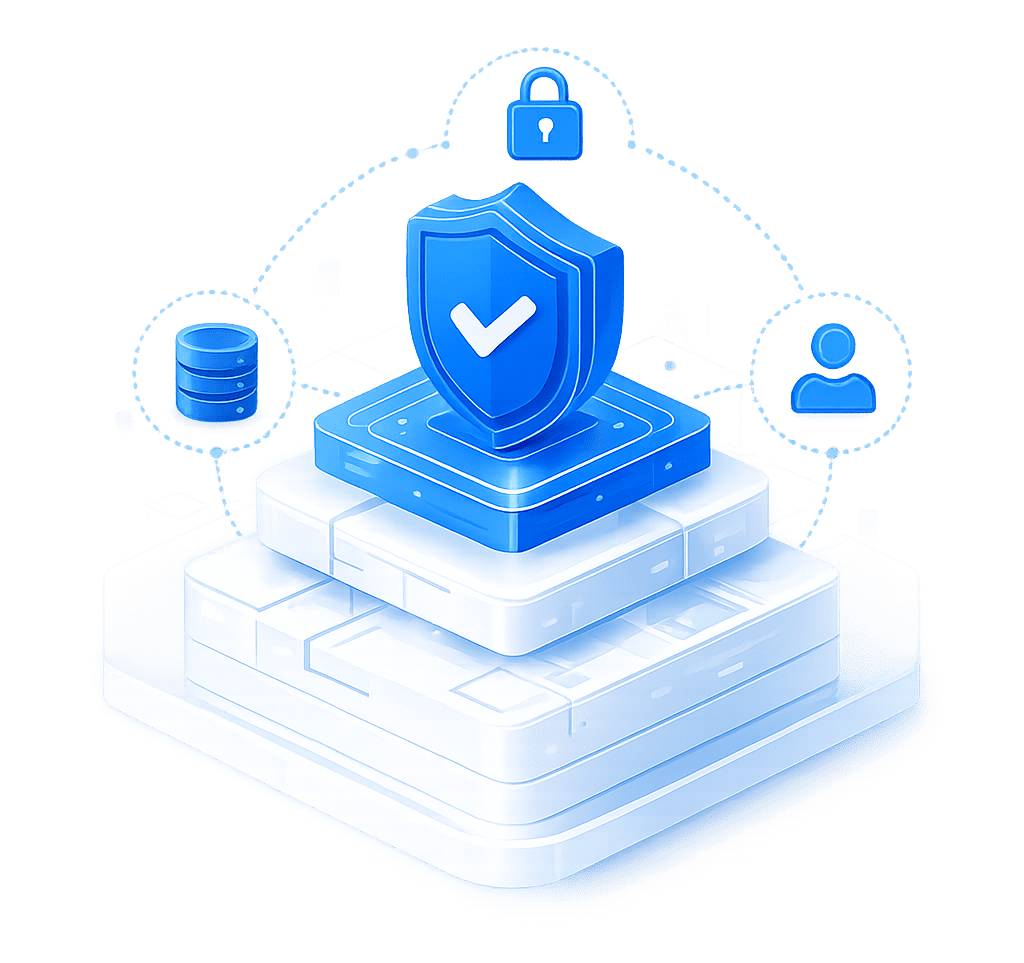
QuickQore secures the platform, the infrastructure, and the code. You secure your accounts, your devices, and your people. Both sides have to do their part for end-to-end protection — and our Terms of Service formally allocate responsibility on this basis.
Answer
QuickQore operates on a shared responsibility model: QuickQore is responsible for the security of the cloud platform — encryption, infrastructure, code, hosting, backups, internal controls. You are responsible for security in the platform — your account passwords, two-factor enrollment, who you grant access to, your device security, and prompt incident reporting. A breach caused by customer-side failure is governed by the customer’s obligations under the Terms of Service.
QuickQore secures
Application code & infrastructure
the platform itself, hosted in tier-one US data centers
Encryption at every layer
AES-256 at rest, TLS 1.3 in transit, HSM-managed keys
Network perimeter security
firewall, IDS/IPS, DDoS protection, 24/7 monitoring
Backup & disaster recovery
3 geo-separate copies with immutable archive
Internal access controls
staff RBAC, audit trails, monthly access reviews
Compliance frameworks
SOC 2-aligned, GDPR, CCPA, PIPEDA controls
Vulnerability management
patching, scanning, third-party penetration testing
Bank API integration security
read-only access via Plaid, never your credentials
You secure
Account passwords
strong, unique, never reused across other services
Two-factor authentication
enrolled and recovery codes safely stored
User access decisions
who you invite, what role they get, when to revoke
End-user devices & browsers
up-to-date, screen-locked, antivirus-enabled
Internal team training
phishing awareness, social-engineering resistance
Network & Wi-Fi from which you connect
avoid untrusted public Wi-Fi for finance work
Prompt incident reporting
report suspicious activity to security@quickqore.com within 24 hours
Security of any data you export
from QuickQore once it’s on your systems
Both sides matter.
A breach of either side can expose data — which is why the QuickQore Terms of Service require both parties to maintain reasonable security practices, and our Data Processing Agreement formalizes the data-controller / data-processor relationship.
Six customer security obligations
When you sign up for QuickQore, you agree to maintain reasonable security practices on your side. These obligations protect both your business and the broader QuickQore community.
01
Use strong, unique passwords
Minimum 12 characters, mixed case, numbers, and symbols. Never reuse across other services. We recommend a password manager.
02
Enroll & maintain 2FA
Enable two-factor authentication and store your recovery codes somewhere safe. 2FA bypass requests must be verified through identity-proofing channels.
03
Manage access carefully
Grant the minimum access each user needs. Revoke access promptly when team members change roles or leave. Audit your user list quarterly.
04
Secure your devices
Keep operating systems and browsers updated. Use device-level encryption (FileVault, BitLocker). Lock unattended screens. Avoid untrusted public Wi-Fi for QuickQore sessions.
05
Report incidents promptly
If you suspect unauthorized access to your account — suspicious logins, unexpected changes, phishing attempts — report to security@quickqore.com within 24 hours of discovery.
06
Protect exported data
When you export data from QuickQore for use elsewhere, that data is no longer covered by QuickQore’s technical controls. Keep exported files encrypted and access-controlled on your side.
Six reasons we’re built differently.
QuickQore was designed inside a real bookkeeping practice, not a venture incubator — and security was a daily concern from day one.
Years bookkeeping
Founder accounting experience baked into every control.
Live client books
Tested across real small business and franchise data.
Real operators
Multi-unit franchisees who manage their own books.
Day-one expertise
Multi-location and multi-entity isolation built in.
Security stack
Same tools used by Fortune 500 fintech — SMB pricing.
Structured ops
Documented, audited, reviewed quarterly — not ad-hoc.
Frequently Asked Questions about QuickQore Security
Plain-English answers to the questions every CFO, IT lead, and security-minded owner asks before signing up.
Answer
The most common QuickQore security questions cover encryption (AES-256, TLS 1.3), bank credential handling, SOC 2 alignment, data residency, internal access controls, data export rights, third-party data sharing, GDPR/CCPA compliance, uptime SLA, incident response, and two-factor authentication enforcement. All twelve answers below are also indexed in our FAQPage schema for AI search engines.
Is my data secure with QuickQore?
Yes. QuickQore uses bank-level AES-256 encryption at rest, TLS 1.3 in transit, two-factor authentication on every login, role-based access control, read-only bank API integration (we never see your bank password), and three geographically separate backup copies of your data. Operational controls are SOC 2-aligned and reviewed quarterly.
Does QuickQore ever see my bank username or password?
No. QuickQore will never ask for your bank login credentials. All bank connections are made via read-only API integration through Plaid. You authorize the connection inside your bank’s own login flow; QuickQore receives transaction data only, never your username or password.
How is my data encrypted?
Data at rest is encrypted with AES-256 — the same standard used by US government agencies for top-secret data. Data in transit is protected by TLS 1.3 with modern cipher suites. Encryption keys are managed in a hardware security module (HSM) and rotated on a documented schedule.
Is QuickQore SOC 2 compliant?
QuickQore’s operational controls are SOC 2-aligned and modeled on the SOC 2 Type II Trust Services Criteria for security, availability, confidentiality, processing integrity, and privacy. Formal SOC 2 Type II certification is in active progress, with target completion in 2026. Independent annual reviews of our controls are conducted by an external security partner.
Where is my QuickQore data physically stored?
Primary data is stored on US-based servers in SOC 2-certified data centers operated by tier-one cloud providers. A geo-separate secondary copy is maintained in a different US region for failover. An immutable offsite cold-storage archive is kept for ransomware-proof recovery.
Who at QuickQore can see my data?
Almost no one. QuickQore staff access is governed by role-based access control with strict need-to-know enforcement. Sensitive identifiers — full bank account numbers and routing numbers — are masked to the last four digits even for internal staff. All staff access is logged, audited, and reviewed monthly.
Can I export my QuickQore data anytime?
Yes. You can export your full QuickQore data — chart of accounts, transactions, customers, vendors, invoices, reports — at any time, in industry-standard formats compatible with QuickBooks, Xero, and major tax preparation software. Your data belongs to you, always.
Does QuickQore sell or share my data?
Never. QuickQore does not sell, rent, or share customer data with any third party for advertising, training, or any other purpose. We do not use your books to train AI models. Confidentiality is contractual, technical, and cultural at QuickQore.
Is QuickQore GDPR and CCPA compliant?
Yes. QuickQore is built to comply with GDPR (EU), CCPA (California), and PIPEDA (Canada) data subject rights. You can request access, correction, export, or deletion of your personal data through the privacy controls in your account or by contacting privacy@quickqore.com.
What is QuickQore’s uptime?
QuickQore maintains a 99.95% uptime SLA on Business and Enterprise plans, with current trailing 12-month uptime of 99.97%. Status and historical uptime are published on our public status page at status.quickqore.com.
What happens if there’s a security incident?
QuickQore maintains a documented incident response plan reviewed quarterly. In the event of a confirmed security incident affecting customer data, QuickQore will notify affected customers within 72 hours of confirmation, in line with GDPR Article 33 and US state breach-notification laws.
Notification timing, scope, and follow-up obligations are governed by your subscription’s Master Service Agreement and Data Processing Agreement. QuickQore Inc. maintains cyber liability insurance coverage to support these obligations.
Does QuickQore enforce two-factor authentication?
Yes. Two-factor authentication (2FA) is enforced on every QuickQore login, on every plan, with no exceptions. Supported methods include TOTP authenticator apps (Google Authenticator, Authy, 1Password), SMS as a backup factor, and hardware security keys (FIDO2/WebAuthn) on Enterprise plans.
Who is legally responsible if there’s a data breach?
Responsibility is allocated under our Shared Responsibility Model. QuickQore is responsible for security of the platform — the infrastructure, code, encryption, internal access controls, and operational processes. The customer is responsible for security in their account — passwords, two-factor authentication, who they grant access to, device security, and prompt incident reporting.
Where an incident is caused by a customer-side failure (compromised credentials, unsecured devices, insider misuse by customer-controlled users), the customer’s obligations under the Terms of Service govern. Where it’s caused by a QuickQore-side failure, QuickQore’s liability is governed by the limitation-of-liability provisions in the Master Service Agreement. QuickQore Inc. carries cyber liability insurance covering its obligations.
Does QuickQore carry cyber liability insurance?
Yes. QuickQore Inc. maintains cyber liability insurance appropriate to a SaaS bookkeeping platform. Coverage limits, scope, and applicability to specific scenarios are described in the Master Service Agreement and available on request to qualifying customers under NDA. Insurance is one part of our incident response framework — not a substitute for the technical and operational controls described elsewhere on this page.
What are my obligations as a QuickQore customer for security?
Under your subscription, you agree to: (1) use strong, unique passwords; (2) enroll and maintain two-factor authentication; (3) manage user access carefully and revoke promptly when team members leave; (4) keep your devices, browsers, and operating systems up to date; (5) report any suspected security incident to security@quickqore.com within 24 hours of discovery; and (6) protect any data you export from QuickQore once it leaves the platform.
These obligations are detailed in our Customer Security Obligations section above and formally incorporated into the Terms of Service. Failure to meet these obligations may affect indemnification rights under your subscription.
Is this Security page legally binding?
This Security page is informational, not contractual. It describes QuickQore’s current security program in plain English. The legally binding agreements that govern your QuickQore subscription are the Terms of Service, the applicable Master Service Agreement, and the Data Processing Agreement. Where conflict exists between this page and your subscription contract, the contract controls. We recommend that customer counsel review those documents in full prior to signature, especially for enterprise deployments.
Limitations & Legal Notice
Reasonable measures — not absolute guarantees
1. No security system is invulnerable.
QuickQore implements commercially reasonable security measures aligned with SOC 2 Type II Trust Services Criteria, GDPR, and CCPA standards. While these measures significantly reduce risk, no security system can guarantee complete protection against all threats — including zero-day exploits, sophisticated state-sponsored attacks, supply-chain compromises, or breaches caused by customer-side credential exposure
2. Shared responsibility governs allocation of risk.
As described in our Shared Responsibility Model above, QuickQore is responsible for security of the platform; customers are responsible for security in their accounts. QuickQore is not responsible for security incidents that result from customer-side failures — including but not limited to compromised user credentials, unsecured customer devices, malicious or negligent acts by customer-controlled users, or failure by the customer to enable two-factor authentication or manage user access in line with these obligations.
3. Cyber liability insurance.
QuickQore Inc. maintains cyber liability insurance to support our incident response and notification obligations. Coverage details, limits, and applicability to specific scenarios are described in our Master Service Agreement and are available on request to qualifying customers under NDA.
4. Incident notification timeline.
In the event of a confirmed security incident affecting your data, QuickQore will notify affected customers within 72 hours of confirmation , in line with GDPR Article 33 and applicable US state breach-notification laws. Notification is delivered to the primary account email and the designated security contact on file. Notification timing, content, and process are governed by your subscription’s Master Service Agreement and Data Processing Agreement.
5. Limitations of liability are governed by your contract.
QuickQore’s liability for any security incident, data loss, or service disruption is governed by — and limited by — the Terms of Service, applicable Master Service Agreement, and Data Processing Agreement in effect at the time of the incident.This page is informational only and does not create additional contractual warranties or representations beyond what is stated in those documents. Where conflict exists between this page and your subscription contract, the contract controls.
6. Customer reporting & cooperation obligations.
You agree to (a) report any suspected security incident affecting your QuickQore account to security@quickqore.com within 24 hours of discovery ; (b) cooperate in good faith with any incident investigation; (c) preserve relevant logs, evidence, and account state during investigation; and (d) refrain from public disclosure of the incident until coordinated with QuickQore. Failure to meet these obligations may affect indemnification rights under your subscription contract.
7. Force majeure & external events.
QuickQore’s obligations under any service-level agreement (SLA) or security commitment are subject to force majeure events — including but not limited to major Internet infrastructure outages, cloud provider failures beyond QuickQore’s reasonable control, natural disasters, government action, and unprecedented cyber-attacks targeting underlying infrastructure providers. Such events are addressed in the Master Service Agreement.
8. Annual security review.
This Security page is reviewed at least annually and after any material change to QuickQore’s security program. The current version was last reviewed on May 2, 2026 by Mohan Patel, Founder and CEO. Material changes are versioned, dated, and announced via the QuickQore status page and customer email.
For Customer Counsel
The full legal terms governing the QuickQore subscription — including representations, warranties, indemnification, limitation of liability, and incident-handling obligations — are contained in the Terms of Service, Master Service Agreement, Data Processing Agreement, and Privacy Policy. We recommend customer counsel review those documents in full prior to signature. For enterprise contracts, we negotiate customized MSA and DPA terms with qualified legal counsel.
Full legal terms:
Master Service Agreement
Data Processing Agreement (DPA)
Sub-processors List
Security is not a feature — it’s a commitment.
From encrypted systems to physical access controls to employee-level protocols — every layer protects your business. If you have questions our security team hasn’t answered here, talk to us directly.